
Thierry Sabine was hopelessly lost.
For miles around him there was only the Libyan Desert, a strikingly harsh section of the Sahara. His motorcycle he had left well behind when it had run out of gas. The situation, to say the least, was bleak. But such are the risks assumed by a racer competing in one of the most challenging rallies of the day: the Abidjan-Nice Rally, or the Rallye Côte-Côte.
The sun was scorchingly hot, and Thierry, a 28-year-old French motorcyclist who had started the rally just a few days earlier with many other racers and had indeed been rather confident of success, felt it slowly sapping his strength. Now his thoughts weren’t even on winning. He just wanted to survive.

It was 1977, and Thierry had set off with ironclad determination from the starting line of the Rallye Côte-Côte in Abidjan, then-capital of the Ivory Coast, in the race’s second edition. Although it had only run for one year thus far, it already had a reputation for being one of the most grueling rallies ever–especially for motorcyclists. The course was a whopping 5,822 miles in total: its path traced from the Ivory Coast to Morocco, then across the Mediterranean in a boat to Spain, and from there overland to Nice–thus connecting one côte, the Côte d’Ivoire, with another, the French Côte d’Azur.
Thierry sat and watched the sunset with the bitter dry taste of sand in his mouth. Not a single other racer was in sight. Nothing but sand and harsh rock surrounded him. Wearily, he took a last sip from his water and laid down in an effort to rest through the night. He might be rescued, but he knew the odds were slim. How could he be found out there, in the wilds of the harsh desert?
With the setting of the sun, a chill wind began to set in. It was at first pleasant after the heat of the day, but Thierry knew it would quickly become as unbearable as the heat had been. It would be as much of a struggle to sleep as it had been to keep going during the day.
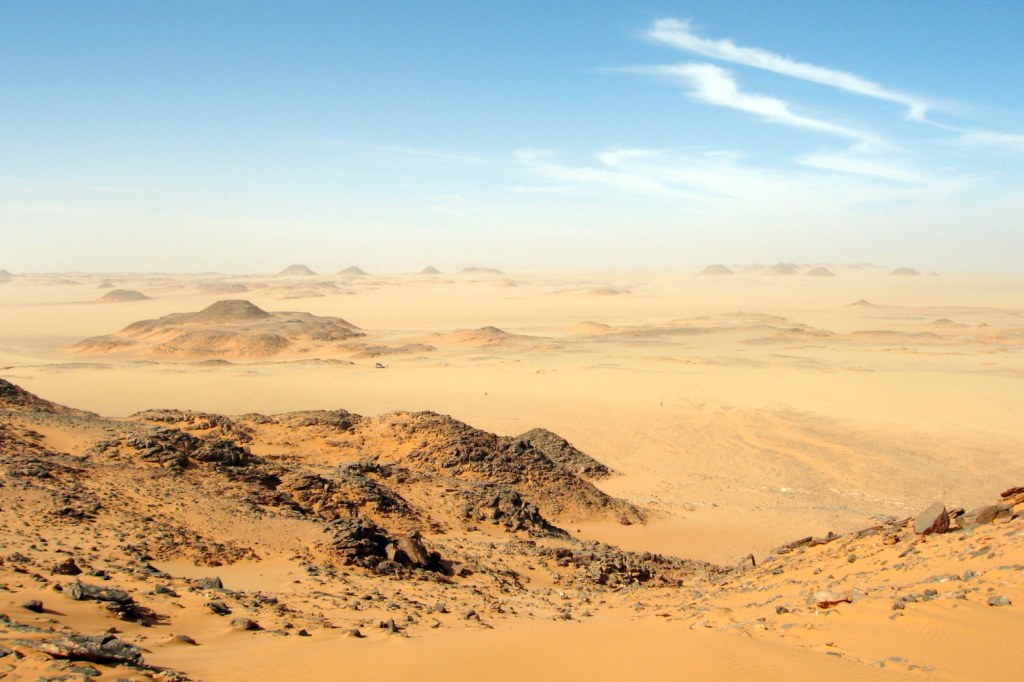
And yet, even as he closed his eyes, he still could see the stunning sunset as if the beautiful landscape of the desert had seared itself into his retinas. To be sure, many would have cursed the cruel wasteland as it condemned them to certain death. Perhaps it was the spirit of adventure that had always burned in him that kept him from such total despair. But even as he shivered in the freezing desert night air, trying to sleep, he could not suppress a certain sense of rapture at his surroundings.
It was a long night before he finally fell asleep, and he awoke early with the sunrise, making his breakfast only of sand and wind along with the last of his water. With nothing more to do, he began to wander aimlessly through the desert, determined to face death bravely on his feet.
By noon, he was no longer looking for a rescue. He was only watching the desert, in all its harshness and yet awesome wonder. Was there anything like the union of pale blue sky and brilliant yellow sand, heaped up in undulating dunes? Was there any landscape more striking–so forbidding and yet powerful? Indeed, nature takes on a very different appearance altogether to the man who is sure of death at its hands.
Night fell once more. Parched, starving, exhausted, Thierry Sabine laid down once more to sleep. Instinct had led him to the highest rocky point he could find, hoping elevation would keep him at least somewhat detached from the wildlife, but the majority of his survival drive was all but extinguished.
He awoke the next day to the sunrise beginning to warm his frozen body and, instead of quickly rising and trying to make forward progress, he simply sat and watched it. It was one of the most beautiful sights he had ever witnessed. At last, after the sun had made its way well overhead, he became restless and staggered unsteadily to his feet.
Thierry wavered for a moment, mustering up the will to move forward. It wouldn’t be long before he lost all strength and simply could not go on. At least, he imagined that’s how the end would come out here. Or perhaps it would be from a scorpion sting, or a slip from treacherous footing on a dune. Only time would tell, he supposed, resigning himself to his fate.
He wandered listlessly for a few more hours. And then suddenly, he heard it.
It was the unthinkable–an airplane engine. And it sounded close, and it seemed to be growing closer.
Astonished, heart racing, he scrambled to the top of a nearby dune with a new burst of strength. There it was! Against all hope, one of the small safety planes that regularly scoured the sky above the course was visible near the horizon.
He shouted and jumped and waved his arms with all his might and didn’t even stop when the plane noticeably came about to wing its way towards him. His heart soared with joy and hope. He was saved!
And so he was. Though he had not finished the race as a contestant, he was met with a hero’s welcome when his plane touched down safely a few days later in Nice. He had wandered on foot over 80 miles from the path of the race. Indeed, it was pure luck that he had been rescued, as he had ventured well outside of the rectangular zone that the safety planes were supposed to cover in their search for any contestants who had gotten off track.
Despite being returned to the comforting embrace of his home and family once more, Thierry was not the sort of man to kiss the ground once safe and bid danger and adventure good-bye. He was a racer and a rallyist, and now that passion for speed was fused with yet another: a love for the desert.
As a matter of fact, his near escape had left him not with a hatred of the Libyan Desert but an adoration of it. Its harshness and cruelty as well as its beauty created an irresistible fusion that exercised a powerful grip over his mind. He wanted more.
And so he gave voice to this passion in the only way he knew how: with a rally.
It was to be called the Paris-Dakar Rally, a spectacular race that covered a whopping 6,200 miles from Paris to the Senegalese capital of Dakar. Its path was notably traced through a broad swathe of the Sahara Desert, placing contestants in the same grueling, unforgiving landscape that had nearly cost Thierry his life.
From the race’s first electrifying start at the Place du Trocadéro on December 26, 1978, the Paris-Dakar became legendary among rallyists. It brought the beautiful desert both to racers and to excited spectators back home. Indeed, even though the route has fluctuated over the years, it is still in existence today. It has always been, as Thierry Sabine declared, “a challenge for those who go [and] a dream for those who stay behind.”
This story, rest assured, is about more than a race and more than a brilliant man, though it has both of those. Most of all, it is about a watch. (Surprise surprise!) An incredible timepiece that would emerge from this passion for the desert sands and would be molded by danger and adventure. It is the incarnation of the Paris-Dakar Rally, the desert, sang-froid, high-octane perils, and even in many ways the incarnation of Thierry Sabine himself: bold, adventurous, and unique.
But that part of the story must wait for another day.
Until then, if you enjoyed, please consider subscribing to stay in touch with Remontoir and follow along with the latest articles! Likewise, feel free to share your thoughts below in the comments. I look forward to hearing from you!
As a disclaimer, this story is not intended to be taken in its entirety as historical fact and involves narrative embellishments based around its very factual core. Likewise, this story does not reflect the exact experiences and opinions of any represented historical personages, and is designed as a retelling of the narrative of the creation behind one of the world’s finest watches. If you have further questions, please contact editor@remontoirblog.com.
Information is from Hodinkee, Wikipedia, Forbes, Hodinkee, Sotheby’s, Wikipedia, Cockpit, and Dakar Rally.

 Remontoir
Share your thoughts!
You must be logged in to post a comment.