“We spared no expense.” – John Hammond, Jurassic Park
The Jurassic Park universe has had a serious hold on me for a long time now. When I first read the book (yes, it’s a book, and yes, I read it before I watched any of the movies), I was captivated by one thing more than anything else. It wasn’t the iconic T-Rex breakout in the rain, or the gruesome death scenes. It was author Michael Crichton’s in-depth depiction of the science behind his science fiction. That biological foundation behind the story captured my attention and actually became the center of my future career dreams for a long time. Call me a nerd, I know.
So if you know me personally, this watch makes a lot of sense as the first one I’ll ever write about on Remontoir. If you don’t, then I’m guessing you will quite a bit better by the time we’re done here. This is one of those watches, I feel, that captures immediately the deep and profound sense of awe that you get from certain things. Like, for example, seeing that massive Tyrannosaurus rex skeleton on display in your favorite natural history museum.
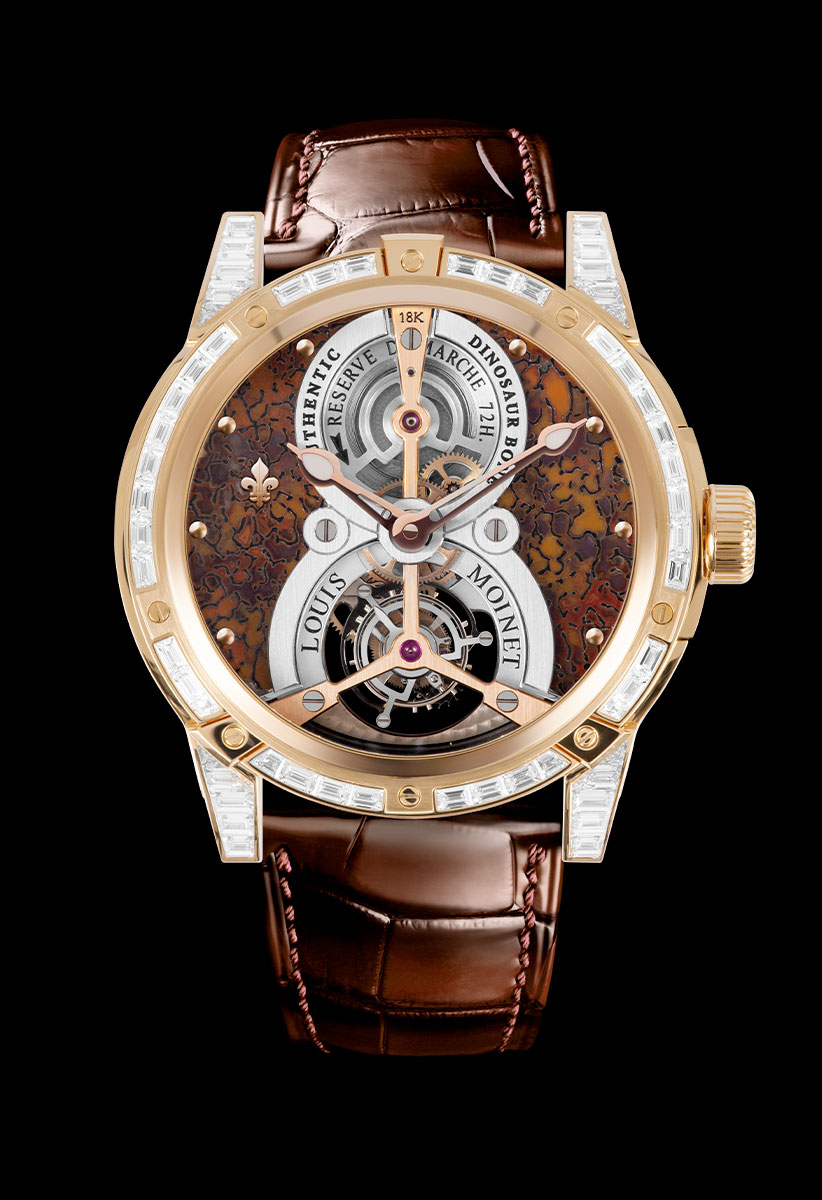
Allow me to introduce you to a truly spectacular timepiece: the Louis Moinet Jurassic Tourbillon. I encourage you, for a moment, to just sit with it, as you would with any fine work of art, and allow yourself to admire it. Here she is.
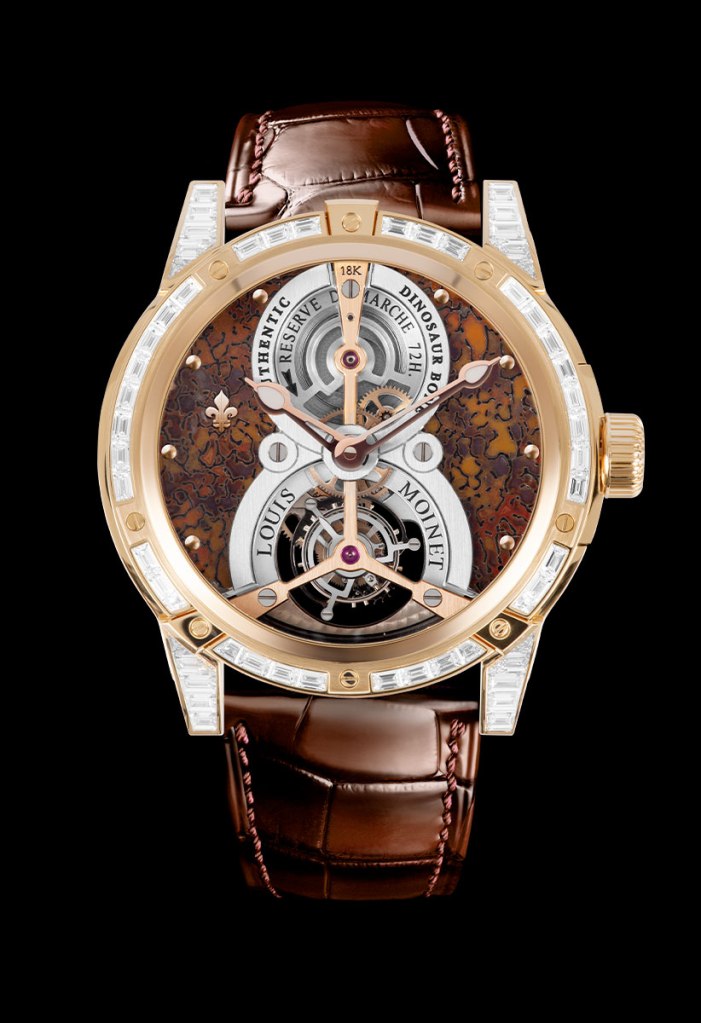
First off, if you’re looking to get your hands on one of these, it’ll set you back a whopping $365,000–or as I like to think of it, about a nice house and a brand new car. That’s also why I felt like that lead-in quote from John Hammond was particularly apt. Some things (like a live dinosaur) are best admired from a distance, eh?
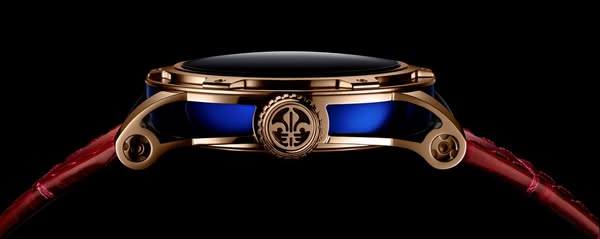
Let me start breaking down what you’re looking at, from the outside in. The case is crafted from 18K red gold, set with 56 baguette-cut diamonds of VVS quality. Interestingly, it’s also combined with heat-blued titanium, creating what Louis Moinet calls their proprietary NEO case. The overall effect is a shockingly modern and eye-catching silhouette for a watch that’s centered around something so old. The watch’s profile is a rather oversized 45.4mm in diameter–but after all, this is not exactly a watch designed with practicality first and foremost on the objectives list. The bezel is also really well done, with screws that are faintly reminiscent of the Royal Oak or a Hublot Classic Fusion. But it’s the dial where this watch really shines.
Most importantly, at the heart of it all is an authentic, 150-million-year-old dinosaur bone. More on that in a second, but it’s without a doubt what makes this watch such a striking timepiece and elevates it from an object that tells time into something more weighty, something historical. Setting that aside for future exposition, you’ll want to examine the rest of the partially skeletonized dial: at 12:00, you can see the mainspring that powers the watch, and at 6:00 the spectacular tourbillon carriage, as well as an extended bridge connecting and supporting these two that reaches over the surface of the dial.
Admittedly, the hands and indices aren’t my favorite. I do appreciate the unobtrusiveness of the pins that mark the hours, and the partial skeletonization of the hands that allows a better view of the dial, but the rounded hands feel at odds with the sharp angularity of the case. It’s a nitpicky point, but one that I felt needed to be made.
Now that basic introductions are done, I think we can go ahead and get to know this watch a little better. Let’s start with the elephant dinosaur in the room: the dial. Louis Moinet is surprisingly tight-lipped about it, actually. They tell us it’s 150 million years old, it’s been authenticated by Dr. Andreas Stucki at the Aathal Dinosaur Museum just outside Zürich, and it comes from a relative of the Diplodocus in a family of large herbivores–perhaps another member of the taxonomic superfamily Diplodocoidea. But we don’t even hear the actual species of the dinosaur. It’s unclear whether the brand even knows that, as it may have been impossible to identify it precisely beyond that general classification. Or perhaps, for whatever reason, they’re just unwilling to divulge it.
What they also don’t say is how this fossil formed and what type it is. After all, it only takes a glance to see that the material composition of this rock is far from your “standard” type of fossil, the brownish rock that you see on display in museums. It’s colorful and distinctly patterned, with warm and varying tones.
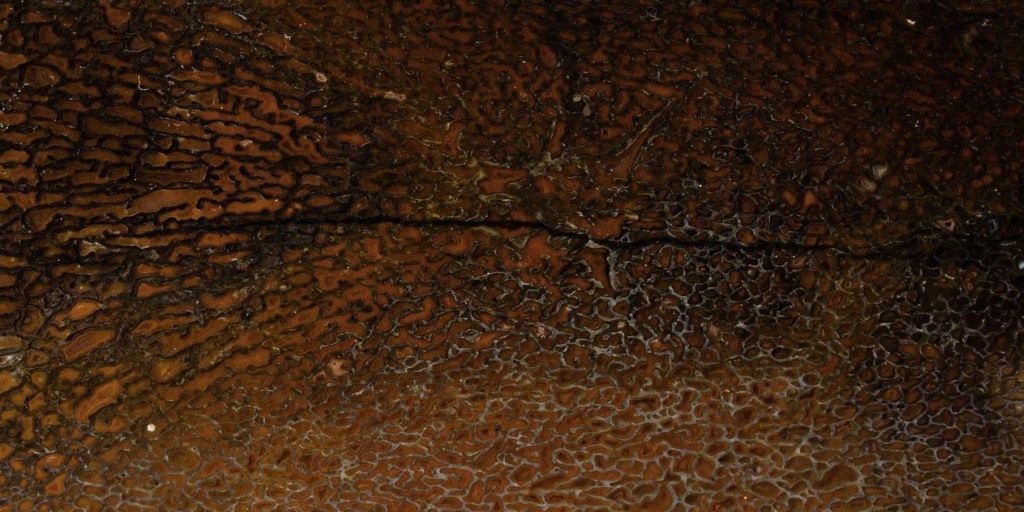
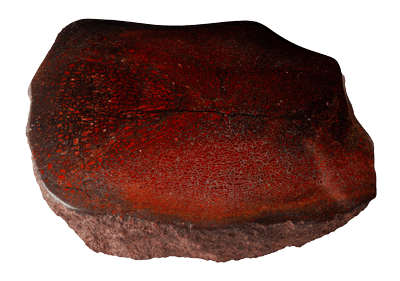
Indulge me for a moment as we get to the bottom of this. When a fossil forms, the bone material inside is gradually worn down by water and replaced by sediments, such that over time what was once bone is preserved in rock in the same shape and form. This process generally takes at least 10,000 years–although interestingly, scientists have recently recreated the process under special conditions in just 24 hours. I digress. In most cases, this is what makes fossils end up with that interesting reddish-brown tint you see so often.
I’m just guessing here, but from the looks of the fossilized dial that Louis Moinet has used for their Jurassic Tourbillon, I’d guess that this is an example of what’s called an agatized bone. This variant, as the name suggests, refers to the formation of agate: a type of quartz chalcedony that often creates beautiful banding patterns and lovely vibrant colors. Just like any other fossil, agatized bones are formed by sediment seeping into the bone and crystallizing–but in this case, the sediment is silica which ultimately crystallizes into agate.
Again, I’m not entirely sure if that’s the case, but that’s sure how it looks to my eyes. I would of course need confirmation from the brand to be sure. But seeing as probably none of you are reading this with your eye on buying the watch, I have no qualms throwing around some educated guesses for your benefit.
Overall, I’m fascinated by this dial. It’s not for the tourbillon or the beautiful gem-set case that I picked this watch to discuss, after all. As a centerpiece, it brings a tremendous gravitas to the timepiece that I find extremely appealing. The famous Omega Speedmaster, often called “Moonwatch,” wouldn’t be the same without the thrilling story of the role it played in NASA’s trips to the Moon. The TAG Heuer Monaco wouldn’t be half as popular as it is today if it hadn’t been featured on the wrist of the legendary Steve McQueen. In the same way, this dial gives Jurassic Tourbillon a unique and fantastical persona with echoes of a bygone era.
On a more personal note, I find that gravitas to be one of the most deeply appealing things about watches. There’s something about an antique, finely-crafted enameled pocket watch that, in my eyes, is priceless. It’s the story the watch has to tell and its connection with history that counts. After all, how many of us have celebrated key occasions by giving or receiving a watch–especially graduations?
This is, without a doubt, one of the finest examples of that connection to history that you’ll find anywhere in the world of horology. At the heart of this magnificent watch is a story 150 million years in the making, to parody the famous Jurassic Park tagline. I find it hard to imagine anything quite as poetic and quite as powerful as wearing the remnant of a creature that walked the Earth eons ago. It’s something that I wish was done more in watchmaking today. Not just dinosaur bones, of course, but a connection to a greater past.
It’s just that very greater past, in a smaller sense, that’s on display in the lovely movement that powers this whole device. (You didn’t really think I was gonna go without mentioning that tourbillon, did you? For shame!) The dinosaur’s heartbeat here is Louis Moinet’s caliber LM35, an extremely precise tourbillon movement that won First Prize in the International Chronometry Competition. That’s impressive enough, of course, and so is the movement’s lovely finishing, but most of all, I love that it’s a tourbillon.
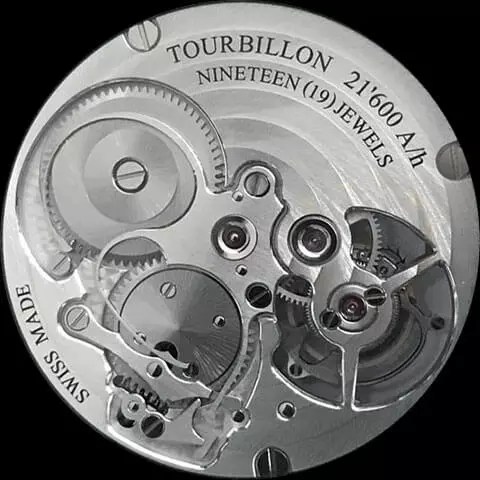
The tourbillon, by all rights, should be dead in watchmaking today. In essence, it rotates the escapement around once every minute to counteract the effects of gravity–something only really needed for a pocket watch that sits in one position all day. A wristwatch, which is constantly changing position and rotation, has no need of it. Yet it’s something old, something tied to the antique past of watchmaking, thanks to its brilliant inventor, Abraham-Louis Breguet. Breguet is the progenitor of an eponymous brand that endures today, as well as a significant legacy in the watchmaking world: he’s almost universally accepted as the greatest of all time.
That link to the past, I’m convinced, is exactly what this beautiful watch is about. It’s almost a little ridiculous to think about, isn’t it? A dinosaur bone on full display in a watch. It’s paying homage to the past. Even the idea of a mechanical watch should, by all rights, be obsolete. So too should be a creature that hasn’t set foot on the Earth for millions of years.
Yet we continue to hold onto and to cherish these memories of antiquity because of the stories they tell. It’s a connection to something greater and more long-lasting.
That, in my opinion, is the purpose of the very finest art.
If you enjoyed this article, please consider subscribing (for free!) to support my work and stay up to date with more reviews like this one.


 Remontoir
Share your thoughts!
You must be logged in to post a comment.